Posted by Michael Haran on Feb 17, 2021
Let’s start things off with a riddle:
The beginning of evolution
Is the end of time and space
The beginning of every end
Is the end to every place
Can you guess the riddle?
Hi, everyone. This is my first weekly post which takes a look the evolution of our species past, present and future. My next post will cover the history of social/cultural evolution and how it has exacerbated the political divide in this country and how we can attempt a fix.
Future posts will explore various topics that are relevant to human advancement as well as our survival on this planet. Topics will be seen through the lens of physical/mental and cultural evolution. The physical/mental, which is explored in this post, considers human evolution through the genetic component and how evolution is being impacted by the human constructs of curiosity, imagination and creativity. Cultural evolution will be examined as it now exists through the evolution of civilization and how it has impacted human relationships and interactions between family and society.
The past four years are a prime example of how civil interruptions can be detrimental to human culture and society’s progress. But on the flip side, one has to question, what is considered progressive evolution and is it always for good or can progress also be evil?
As D.T. Max asked in his April of 2017 National Geographic article “Beyond Human:”
“Are we on the way to redefining how we evolve? Does evolution now mean not just the slow grind of natural selection spreading desirable genes, but also everything that we can do to amplify our powers and the powers of the things we make – a union of genes, culture, and technology?
And if so, where is it taking us?
First the Past
Evolution on planet Earth has never stopped – it is relentless. When the chances of any living thing’s survival can be increased, nature will find ways to mutate to make it happen.
Primates diverged from other mammals about 85 million years ago. A major climate shift happened between 3.0 and 2.5 million years ago marking the onset of Northern Hemisphere glacial period. This period generally coincides with the timing of the origin of the genus Homo which leads us to, Homo Sapien.
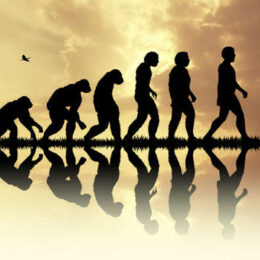
The oldest known skeleton of a modern human dates to about 200,000 years ago. Modern humans evolved beginning with primates which lead to the emergence of Homo Sapiens as a distinct species. This process involved the gradual development of traits such as upright walking and language. Modern human language is thought to have begun about 100 thousand years ago and we haven’t shut up since. Humans are thought to have migrated out of Africa about 60 thousand years ago, about 20 thousand years before the Neanderthal species died out. The question of whether the Neanderthal was killed-off or interbred with Homo Sapiens is still a matter of debate. Because modern humans have a small amount of Neanderthal DNA it supports the interbreeding theory. Plus, our Neanderthal relatives can be seen on any given Sunday playing football as NFL lineman.
It was thought that human evolution took millions of years but over the past 3,000 years, many populations have evolved genetic adaptations to their local environments. As humans migrated north their skin lighten to allow the absorption of Vitamin D in the shorter daylight environment. People in Siberia and the high arctic have developed metabolisms that are uniquely adapted to survive extreme cold; the Bajau people of the South Pacific can dive 70 meters and stay underwater for almost 15 minutes because of unusually large, oxygen holding spleens like deep diving seals; people that live in the Hymnals have evolve to flourish in a lower oxygen environment. Three thousand years sounds like a long time but it’s the fastest known adaptation ever to have evolved in humans.
Now the Future
Biological evolution may be unstoppable and more skillful than the genetic evolution humans can initiate with crossbreeding in plants and animals, but how important is it, measured against the adaptations we can devise with our amazing brains? As the futurist Ray Kurzweil said, “We will transcend all of the limitations of our biology. That is what it means to be human – to extend who we are.”
It’s clear that human evolution isn’t over. Surviving to reproductive age is what drives natural selection, the force behind evolutionary change. The big question is, will our technological and scientific innovations impact our evolution?
Modern medicine has allowed longer survival which becomes encoded as part of evolution. Good sanitation, antibiotics and vaccines all make differences between genes less important and modern medical procedures that prevent death all tend to stop natural selection through genes, allowing survival to a reproductive age. Modern medicine also allows genetic drift which makes genetic differences vary randomly within a population because harmful mutations don’t kill people and thus are not eliminated. These modifications are not to genes themselves but to when and how those genes are expressed, the science of which is called Epigenetics. These changes can happen in as short a time frame as one lifetime and be passed on to offspring. For example, human drug addiction has been shown to be pasted to offspring through the sperm and egg in a single generation.
Technology now does much of the same work and does it far faster, bolstering our physical skills, deepening our intellectual range, and allowing us to expand into new and more challenging environments.
A prime example is the new technology called CRISPR-Cas9 which is a procedure to snip out a section of DNA sequence from a gene and put a different one in, quickly and accurately. What used to take researchers years now takes a fraction of the time. No technology has remotely existed before that is as powerful for the manipulation of the human genome. Designing synthetic cells beyond the bounds of evolution (so called “Designer Cells”) is encompassing everything from reengineering pig embryos to make their organs safer for human transplant to trying to fix the genetic defect in human embryos. The moral implications of playing God or creating a Hitler type super-race have to be weighed against the ability to correct natures mistakes by producing disease-free embryos. At this time there is an international moratorium on all therapies for making heritable changes in human genes until they are proved safe and effective. CRISPR is no exception.
Most scientist don’t think the ban will last. Some pointed to the history of in-vitro fertilization (IVF) as a precedent. It was first touted as a medical procedure for otherwise infertile couples. Soon its potential to eradicate devastating genetic diseases was clear. Evolution is not benign and much human suffering has come from nature’s mistakes. As IVF became more familiar, its accepted purpose spread from preventing disease to include the designer cells of sex selection and even choosing desired hair and eye color.
CRISPR is a vastly more powerful technology than IVF, with a far greater risk of abuse. But the moral issues aside, the potential benefits of applying CRISPR to humans are undeniable and many feel that as soon as CRISPR is shown to be safe, ethical questions will recede, just as they did with IVF. There are already 2,300 CRISPR gene therapy trials under way, including for anti-aging and Alzheimer’s disease.
As George Church, a molecular engineer at Harvard and MIT stated, “DNA was left in the dust by cultural evolution. But now it’s catching up.”
Riddle Answer:
The letter E
Read More
Posted by Michael Haran on Feb 12, 2018
By Michael Haran
The following link shows the counties that Trump won in an inter-active format. http://time.com/4587866/donald-trump-election-map/?xid=emailshare The site states, “At present count, Trump snagged 220 counties that voted for President Obama in 2012, while Clinton poached 17 that went for Mitt Romney.” Most of these counties are in the rust-belt swing states. California has 14 Republican Congressional House seats. If seven can be flipped to Democrats that would represent nearly a third of the 24 seats Democrats need to take control of the House. Nationwide, the Democratic Congressional Campaign Committee has identified 59 Republican-held districts they believe can be won by a Democrat.
As important as taking back the U.S. Congress is it is just as important for the Democrats to fare well in the 36 gubernatorial contests and thousands of state legislative races next year, where Republicans currently hold a 3,034 to 2,317 advantage. The past 10 years have eroded the Democratic base, as fewer ideas are percolating up from the states. Republican gerrymandering has cost at least a dozen House seats and hundreds in state legislatures. State governments also often serve as training grounds to develop candidates for higher office and provide national awareness.
In 1979 the Republicans were in the same boat the Democrats find themselves today. The Democrats controlled all three branches of government and the gloom of the post-Watergate era hung over them like a rural graveyard fog. Then along came Ronald Reagan with his upbeat message. He projected a can-do optimism that was welcomed after a series of economic, military and political shocks, tailoring his conservative message to appeal to the gas station attendant, as well as the wealthy country club set. In 1980, Republicans won a majority in the Senate for the first time in more than 25 years and made major gains in statehouses as well.
Most political party comebacks are marked not by some innovative policy agenda, but by connective messages and powerful personalities like Bill Clinton, Barack Obama and Trump. It’s not about ideology or 17-point policy prescriptions. “In 2016, the problem was not about an agenda; we had that,” said Paul Begala, a leading Democratic strategist and close associate of Bill and Hillary Clinton. “The problem was message.”
Last month, Democratic congressional leaders put out a “Better Deal” agenda, a familiar litany of proposals like a higher minimum wage, lower drug prices, more job training and less corporate welfare. As stated by Albert R. Hunt in his article “Democrats need a fresh message to win in 2018,” for the Bloomberg View, “Although it does have its uses, bold or innovative it’s not. It’s a good organizing tool for candidates to be more than just anti-Trump,” said Stephanie Cutter, a former deputy campaign manager for Obama and a strategist in the successful 2006 Democratic campaign to win back a majority in the House. A much better slogan would be “LET’S DO IT!” This slogan works on many levels plus it sounds fun and exciting.
What I think would be a great idea, would be to put a number of cargo vans (like the Ford 250 Transit which you can stand up in) on the road in every Republican-held congressional district that has a chance of flipping to the Democrats in 2018. These vans, which will have LET’S DO IT! painted on the sides, should carry a team with the Democratic candidate into these counties and towns and hold a town-hall style BBQ and talk to people about how they feel about jobs, healthcare and education.
This program would target the areas where disenfranchised voters switched to Republican to tell them the truth about Trump (although most know it by now) and, by the time this project is rolled out (in time for the mid-term 2018 elections), Trump the fraud and con artist should have been well-cemented in people’s minds. The message would focus on retraining people to work in the service sector or tech sector since many of the jobs lost are not coming back because they were either replaced by more efficient green energy alternatives or were automated. The United States has the most advanced service economy in the world and there is no reason why people should not take advantage of it. From the commentary patterns that emerge, scripts would be written with enough flexibility to adjust to a particular community’s sentiments. This data could help determine the message on the local, regional, and even national levels.
The message should also be authentic and crafted in a way that avoids issues like abortion, uniformity on transgender soldiers, higher corporate tax rates, lower defense spending and impeaching Trump – all political poison policy proposals that won’t play well in closely-fought battlegrounds that Democrats need to win. The mistakes that Clinton made in saying to the coal country that, “your jobs are not coming back” or to the wealthy Democratic donors, “your taxes will be going up” have to be avoided. These issues may be true but you don’t state the obvious. The same has to be done when referencing Trump. Never state the obvious. Motivating and getting people to engage is a three-step process:
- First, the issue presented requires an emotional response;
- the second phase is reflecting or thinking about the particular phenomenon;
- and the third phase is action
If successful, an authentic message will be sufficiently motivational to get people to engage to help reverse the true ugliness that has been unleashed by this administration.
This program can work on the state and local level too. Although the message would have to include local and regional issues (as Tip O’Neill said, “All politics is local.”), there will be plenty of Democratic contenders to help field-test the party’s message. The experiment will be successful if it yields messengers who best counter the failings of Trump. Starting at the lowest level of elected officials, like local school boards, candidates must know about governing without appearing to be elitist, who can be dignified as well as approachable, are persuasive in articulating Democratic themes like the dangers of income inequality and wage stagnation, and just might be able to create some local enthusiasm.
Over the past ten years I’ve watched California State Senator Mike McGuire (D-Healdsburg) come of age. At 19 years old, he was the youngest person ever elected to the town school board. He studies the issues and listens to constituents. He suffers fools graciously and will listen to anyone until one of his aides drags him away. I think Mike has learned many of his campaign sensibilities from successful senior elected officials. If structured correctly, I think this program might have the potential to help hone the skills of the next generation of Democratic leaders.
If there is one lesson learned from the Trump phenomena, it is that people want to be heard; they do not want to be neglected; they do not want to be patronized. If you want their vote, people have to truly feel that they are cared about – even loved. If necessary, this literally has to be accomplished one person at a time. The best elected officials know this instinctively. At a recent Democratic dinner meeting Congressman Jared Huffman (D – San Rafael) was excited at the potential up and coming crop of new Democratic candidates.
I think this is a solid way of getting boots-on-the-ground in contested national, state and local districts to reintroduce the Democratic Party as the working man’s party, an image that got away from us in the 2016 election. So, fire up those burgers and LET’S DO IT!
Read More