Posted by Michael Haran on May 10, 2013
Letter to the Editor
Healdsburg Tribune
May 9, 2013
Truth, Honesty and Trust
I’m sure I’m not the only one getting tired of the week after week negative Foss Creek Letters to the Editor but as Carolyn Moore noted “It’s not going away.” The Foss Creek Circle issue is looking more and more emblematic of our current city council. Based on the overwhelming negativity of this project you’d think that by now the council would have been honest enough to admit that this one-way street business was a bad idea, changed it back and moved on to more important city matters. But it hasn’t and it’s beginning to look like the council thinks it can get its 3-2 way by stonewalling and hoping the town will get tired of the fight.
This thing seems to be a pet project of one of the councilman. I think there have been more negative Letters to the Editor about this than the number of people in the bogus survey used to justify this project. In Gary Buchanan’s Letter “Close Call,” he referred to Gary Plass’ response as “glib” to a near accident. I don’t think his response was “glib” at all I think it was condescending.
I’m starting to sense that this council feels it can do whatever it wants without regard for the community. The town has a limited amount of money to spend on foolish projects. Two councilmen (woman) of all people, knows we need every cent to pay for the city’s bloated unfunded long term liabilities. Unless they think they can just do Measures N, O and P to raise more tax money and the town would happily go along. Or maybe they could convert the town’s beloved library into an office building. Sound too farfetched? Don’t kid yourself they have already talked about it.
The council’s justification for Foss Creek Circle was that no one showed up to protest. People have to work and they don’t have time to show up for every council meeting. When this council was elected people thought they were getting representatives that would look after the town’s interests. They said the decision was made because Silver Oak needed the changes for their deliveries which turned out to be not true. I’m beginning to believe this council’s attitude with each other is “we’ll vote for your pet project if you vote for mine.”
The counsel has asked the town for suggestions on how to spend the Measure M funds. The whole town better show up because if they don’t who knows what the council will spend the money on and with the restoration of the $13.5m bond money maybe we need a citizen’s ad hoc oversight committee to keep this money from being wasted. Where’s the trust?
Michael Haran is a Healdsburg resident
Read More
Posted by Michael Haran on Apr 20, 2013
Close to Home
Teachers Need the Tools
By Michael Haran
4/19/2013
Published in the Press Democrat 4/20/2013
After reading Andy Brennan and Simone Harris’ Close to Home article (A teacher’s perspective on improved learning PD 4/4/13) and Bill Gates article (Here’s a fairer way to evaluate teachers PD 4/5/13) on teacher evaluation neither article addressed the new curriculums that are now being developed by K-12 textbook and eBook publishers and the evolution of K-12 teaching methods.
Under Obama’s Race to the Top states are required to meet three main educational criteria: adoption of rigorous academic achievement standards; a program to focus on turning around low performing schools; and the most contentious provision, an accountability system that would involve using test scores to evaluate teachers and principals.
In 2010, California became one of 45 states to adopt the new Common Core State Standards (CCSS) Initiative to meet these criteria and the transition is now under way. Assessments aligned with the standards are also being developed and are expected to be in place for the 2014-15 school year, replacing the STAR tests. The new standards and skill requirements have been developed with the goal of creating consistency across the country.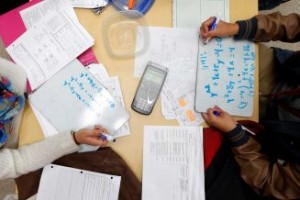
The California Legislature in March 2011 suspended the adoption of instructional materials until the 2014–15 school year. This was due partially to budget cuts but also to allow time for publishers to adapt instruction materials to the Common Core State Standards (CCSS).
Just like a good race car mechanic a teacher needs sound methodology and precision tools to be successful. Anyone who studies K-12 education knows that the industry has long needed a makeover. Everything evolves and we are now watching an evolution in teaching structure. Many school districts are experimenting with, if not outright adopting, the progressive teaching/learning model called “Flipping the Classroom.”
In flip teaching, the student first studies the topic by himself, typically using video lessons created by the instructor or those provided by an Open Education Recourse (OER), such as the Khan Academy. In the classroom, the pupil then tries to apply the knowledge by solving problems and doing practical applications. The role of the classroom teacher is then to tutor the student when they become stuck, rather than to impart the initial lesson. This allows time inside the class to be used for additional activities, including use of “differentiated instruction” which is more student specific and “project-based learning” which is the practical application.
In another progressive teaching/learning model North Carolina State University College of Education has developed program which they call the FIZZ concept. With this program students video themselves reciting a lesson. The object is to allow students to revisit the video to evaluate and analyze not only what they have learned but also what their peers have learned. The objective is to give the student “ownership” of the lesson which they call the highest level of learning.
Along with the evolution of teaching methodology the next generation of K-12 instruction materials needs to be written to align to these and other progressive teaching models. The publishers now have an opportunity to incorporate modern learning technology with the four predominate student learning styles which are: Linguistic (“word smart” they learn by writing and reading); Logical-mathematical (“number/reasoning smart) Spatial (“picture smart” they learn from images); Bodily-Kinesthetic (“body smart” they need to be moving to learn). I think “Bodily-Kinesthetic learners are many times misdiagnosed with having ADD.
If you want to increase test scores give teachers curriculum that develops the coveted goals of critical thinking, collaboration and communication in all students. You can’t win the race without the right tools.
Michael Haran is research director for the Institute of Progressive Education and Learning.
Read More